LIV Golf is done. On Thursday, Nov 5, its lawyers told a bankruptcy judge in New Jersey that the league will wind down and liquidate, after BC Partners walked away from a promised $300M rescue. That closes the book on about $5.3B from a single funder, the Saudi Public Investment Fund, which stopped funding after the 2026 season. The final LIV tournament was played Aug 23 in Indianapolis. The league never turned a profit in five seasons.
The numbers behind the collapse are stark. LIV's UK entity lost $243.7M in 2022, $395.9M in 2023, and $461.8M in 2024, on revenue of $64.9M in 2024. Group revenue for 2025 was about $208M, per the bankruptcy filing, against a burn rate near $100M a month. The league distributed about $1.3B in prize money and guaranteed more than $1.6B in player contracts, including a reported $300M plus for Jon Rahm. Television never became a business: LIV averaged 386k viewers across 14 Fox telecasts in 2026, and broadcasting was only about 5 percent of 2025 revenue. The league paid for its own production. When the funder stopped, there was no business underneath to catch it.
Pickleball's biggest league sits on the other side of the same question, with a very different answer so far. In May 2026, Apollo Sports Capital led a $225M structured investment into Pickleball Inc., the parent of the Carvana PPA Tour and MLP presented by DoorDash. The valuation was not disclosed. Sports Business Journal reported about $750M, and The Kitchen reported about $800M, so treat the valuation as reported, not confirmed. Pickleball Inc. reported combined revenue above $140M in 2025 across its leagues, retail, software, media, and court businesses. The leagues alone run near $64M to $70M a year.
That is where the tightrope starts. Pickleball Inc. pays about $33M a year to roughly 130 contracted players, about half of league revenue, a ratio inflated by the 2023 bidding war between the PPA and MLP that neither side could afford. The 2026 restructuring is already cutting that down: final year guarantees are being spread across 2026 to 2028, Gold Card contracts have stopped, and pay is shifting toward performance. Breakeven is not claimed until 2027. The top of the pay scale is real money, with Anna Leigh Waters reportedly earning $10M plus over three years on her paddle deal and the first pickleball deal in Nike history, but the bottom 80 players average about $30k in league pay, per independent estimates.
Three LIV failure patterns show up at the PPA in miniature. Player pay running near half of revenue. Franchise valuations without cash flow: MLP teams sold for $13M and $16M in 2025 while the average club reportedly took in under $0.5M against more than $800k in expenses, a single source figure worth flagging. And weak media rights: there is no disclosed rights fee, PickleballTV is owned distribution, and the CBS records, 791k average for a PPA broadcast and 499k for MLP, are windows, not a rights market. Dependence on outside capital is the thread through all three. Apollo is a financial investor with an exit horizon, not a sovereign fund, but if it loses patience the way PIF did, the leagues face the same cliff at a smaller scale.
Where pickleball is structurally different is the demand side. LIV tried to manufacture demand for a new format in a mature sport whose audience already had an incumbent. Pickleball participation grew from 4.2M Americans in 2020 to 24.3M in 2025, per SFIA, and the pro tours sit on top of a paying amateur pyramid: entry fees, about 4,500 tournaments a year on PickleballTournaments.com, and a vertically integrated business that sells the paddles, the software, the courts, and the broadcast. A pickleball event needs rented courts, not a golf course and a $30M purse, so the break even audience is far smaller. Sponsors are real and multi year, with Carvana and DoorDash on the titles, and no major exit has been reported. The calendar is growing, attendance per event is up, and the 2026 season ended with full crowds and a $1.6M purse at Worlds.
The caveat is that almost every bullish pickleball number is self reported by the leagues or their investors, unaudited, and sometimes internally inconsistent. Facility distress is already real: The Picklr's parent filed Chapter 11 on Oct 9, 2026, and other venue operators filed in 2025 and 2026. Participation growth cooled sharply in the first half of 2026, up only 1.3 percent, per SFIA. The risk is not a LIV style sudden death. It is a slower squeeze: if participation plateaus, sponsor and franchise valuations built on growth assumptions compress, and the 2026 pay restructuring alienates players, the path to the promised 2027 breakeven narrows.
Run through the 12 proxy health check for private leagues, the PPA scores five green, four amber, and two red. The reds are franchise cash flow and media rights, the same two that killed LIV. The ambers are the pay restructuring, participation cooling, and a bridge loan reported by a single newsletter in early 2025. The greens are sponsor quality, completed franchise sales, a growing calendar, rising per event attendance, and stable leadership. That is not a league in LIV territory. It is a league with two red flags that rhyme with the ones that killed LIV, and two years to turn them green.
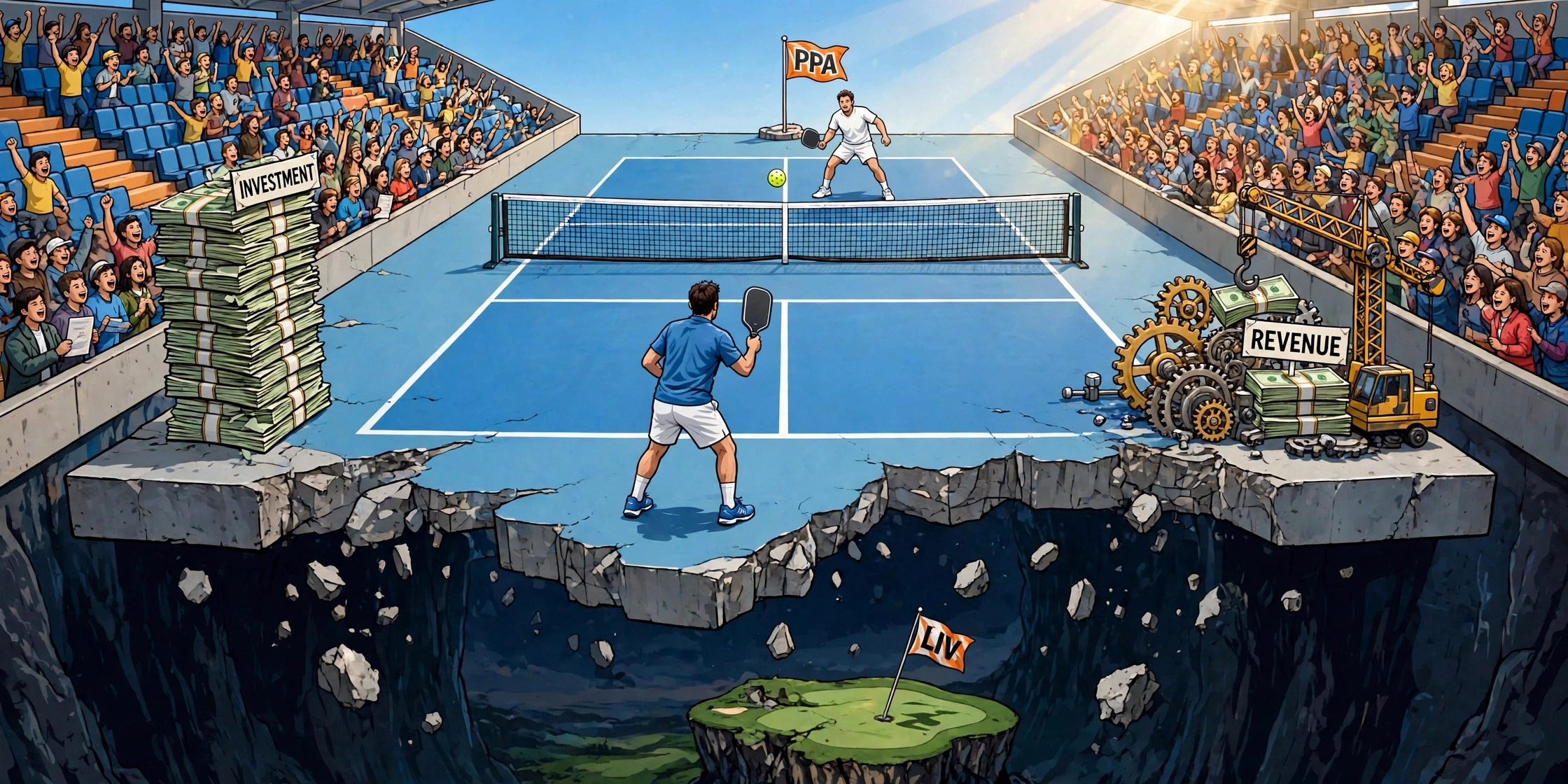
What would have to be true for the PPA to fail like LIV? Participation would have to stall long enough for the growth story to break, sponsors would have to start leaving instead of renewing, franchise buyers would have to stop closing deals at rising prices, and Apollo would have to decide its $225M is not worth another round. None of that has happened. All of it is observable, which is the point. The next two years answer whether the revenue stack in the picture above catches the investment stack, or whether the crane stops moving.
For regular players, the stakes are the ones this publication always comes back to. If the pro money is built to last, some of it reaches courts, juniors, and leagues. If it is built on patience that runs out, the trickle stops, and the rec game is left holding the bill for a party it did not throw. Watch the bankruptcy docket first: LIV's wind down plan and disclosure statement are due Nov 9, the creditors committee meets Nov 20, and the next hearing is Nov 24. Then watch the PPA's own calendar: the P125 Lille, Nov 13 to 15, and the Proton Daytona Beach Open, Nov 16 to 22. Sources: Front Office Sports, Sports Business Journal, the PPA Tour Apollo announcement, and the Worlds Championship Sunday recap.
Why it matters: The comparison is not that pickleball is LIV. It is that both pay players with money that arrived before the revenue did. Pickleball has what LIV never had, a paying amateur base, cheap venues, and sponsors who sell to the people in the stands. Whether that is enough is what the next two years answer.